










New businesses form in vast numbers each month, with U.S. Census Bureau data showing that 531,728 applications were made in August of 2026 alone. While this represents a year-on-year decline of 7.8%, it still indicates strong economic activity and a growing emphasis on entrepreneurship.
Similarly, SBA data shows small businesses employ 62.3 million people nationally, equivalent to 45.9% of all employees. So, if top-level disagreement occurs and a business' future is jeopardized, the implications are significant, as both owners and employees may suffer. In response, many business owners are rethinking how they structure ownership early on.
Partnership agreements provide clarity when conflicts arise and offer a platform for investment and growth. In turn, up-and-coming companies can build toward long-term commercial viability, whatever external forces may affect them. Below, Underwood Law, a California partition action law firm, examines what current ownership trends and partnership planning mean for entrepreneurs in modern America.
Planning for All Potential Eventualities
Top-level data on the fate of businesses in the U.S. makes it clear why flexible, long-term ownership arrangements are recommended for many smaller organizations. The Bureau of Labor Statistics' July 2026 figures on job gains and losses illustrate this need unambiguously. Q4 2025 job creation of 7.5 million was contrasted with 7.2 million jobs lost as private-sector businesses closed their doors for good.
The same report points out that in Q1 of 2025, the most recent quarter for which statistics are available, 284,000 companies were wrapped up. Another BLS report throws the long-term likelihood of a business surviving into stark relief. 34.7% of enterprises tracked between 2013 and 2023 survived the full decade, leaving almost two-thirds out of action. Failure rates vary across industries, but even in the best-case scenario, the 10-year survival rate is 50.5%.
In simple terms, most businesses fail or face serious upheaval within the first few years. If co-owners don't plan for a company's closure or sale early on, they may butt heads. Doing so can involve additional costs stemming from legal action and mediation.
Business owners should consider what the ownership structure can provide as an appropriate path forward, given likely disputes. Many founders are doing just that.
Appreciating Ownership Trends
How business ownership is determined matters as much as how many companies are being created and which agreements apply to their formation. A useful report from Carta on founder ownership trends across 45,000 start-ups found that, in multi-owner scenarios, the initial equity split has become more often equal over the past decade.
In 2015, only 31.5% of start-ups with two founders opted for equal equity division, whereas by 2024 that proportion had risen to 45.9%. The slight majority (54.1%) elect unequal splits, requiring explicit buy-in and role agreements up front. This may signal both a growing understanding of the need for clarity and equality at the start of a business' journey. It may also point to an associated uptick in partnership agreements tied to this ownership trend.
While this data paints a positive picture of how the rapid rise in entrepreneurship is playing out, there's another, less optimistic angle to consider. Specifically, Gallup reports that 52.3% of small businesses are owned by those aged 55 and over, putting them in a demographic approaching retirement. Of the 30 million businesses with no employees, only 35% have plans for how to conclude their involvement upon retirement, whether through a sale or gifting to a family member. This leaves most without a succession plan, significantly increasing the likelihood of disagreements and conflicts.
This is thankfully different for employer businesses, where 74% have some sort of strategy in place for their eventual retirement. It also suggests that partnership agreements may benefit the next generation of entrepreneurs, as they will be better positioned to handle the sale or transfer of the business in decades to come.
Investigating Additional Partnership Data
While the IRS doesn't track partnership agreements specifically, it does collect data on the number of partnerships nationwide. In 2023, the most recent year for which statistics are available, partnerships filed 4.5 million tax returns, a 1.7% year-on-year increase. Moreover, the number of individual partners rose 5% to 30 million.
The data also distinguishes business structures: 72.7% of partnerships are LLCs, and 9.7% are limited partnerships. Total partnership assets reached $57.3 trillion, with receipts of $12.0 trillion reported by the IRS.
Beyond illustrating the scale of business partnerships in the U.S., these statistics also highlight the importance of having formal agreements. Again, formal data on partnership agreements specifically is lacking, so conclusions can be drawn only from what is known. IRS filings show that individual partners are increasing, LLCs account for the lion's share of companies in this category, and smaller companies are most vulnerable to disruption in their early years.
Companies with only verbal contracts between co-owners risk serious repercussions if disputes arise. Partnership agreements prevent this, and the increase in equal equity splits in startups suggests they're being implemented more regularly as founders learn their value.
Protecting IP and Equity in Multi-Founder Entities
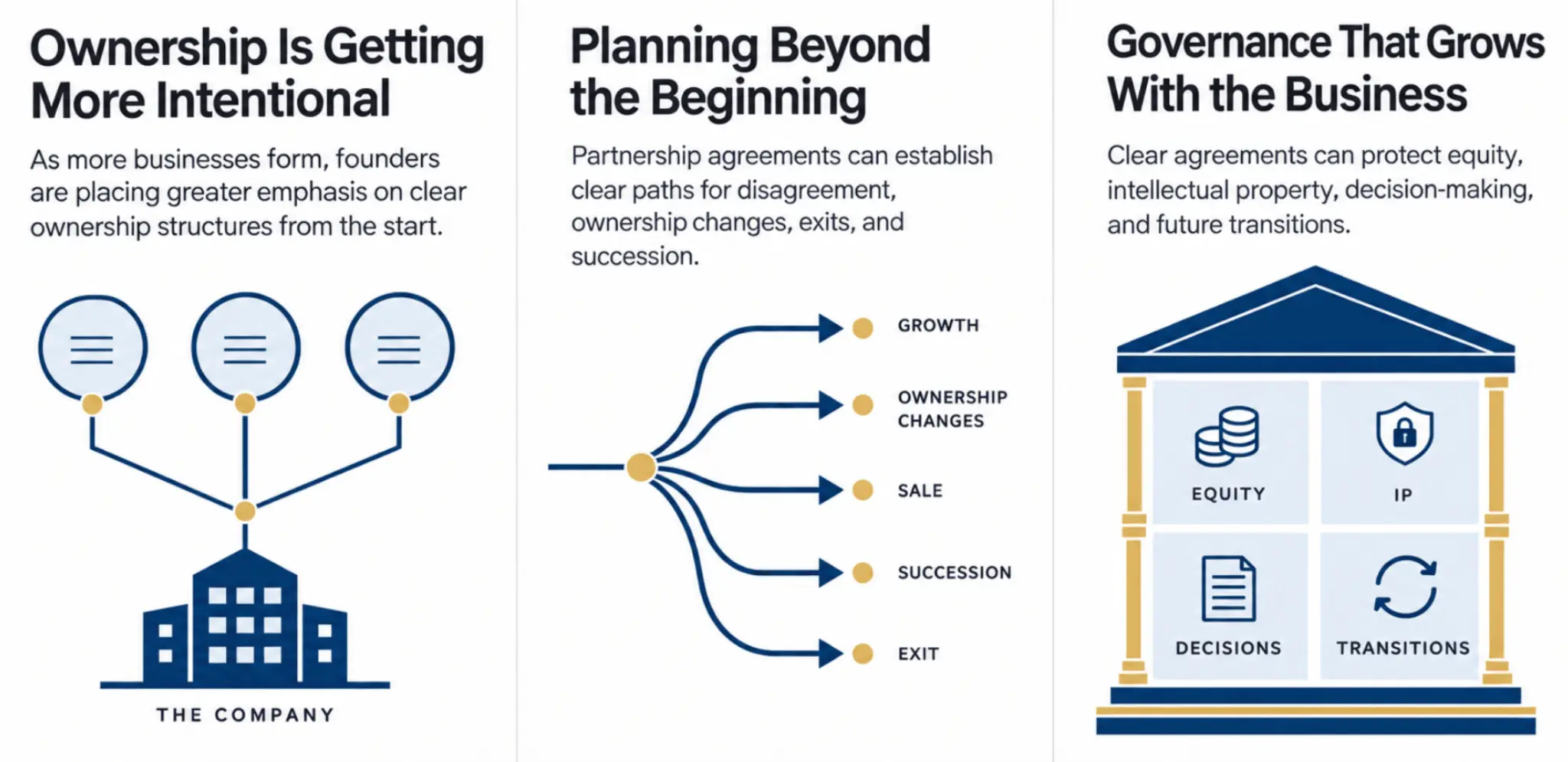
As business ownership models evolve, partnership agreements must do far more than outline basic equity splits and profit distribution. Modern agreements increasingly need to protect intellectual property, clarify operational decision-making, and govern how equity vests over time.
When founding teams bring disparate assets to the table, such as proprietary code, customer lists, or specialized domain expertise, an agreement provides the formal structure required to ensure those assets remain with the company. Clear vesting schedules prevent scenarios where an early-departing founder leaves with a substantial chunk of equity, safeguarding the remaining partners and future investors.
It goes without saying that business owners can't do all of this alone. Working with experts to hammer out the agreements that define ownership and minimize the likelihood of conflict is the best route forward, and one that every owner should strive to follow.
Aligning Long-Term Strategy with Dynamic Governance Structures
A well-structured agreement serves as a dynamic governance blueprint that grows alongside the organization. It establishes predefined mechanisms for handling capital calls, bringing on new partners, and resolving disputes through mediation rather than costly court battles.
Proactively codifying exit strategies, buy-sell provisions, and valuation formulas lets co-founders ensure that future transitions remain straightforward and transparent. Ultimately, laying this structural foundation gives emerging enterprises the legal stability and operational resilience needed to navigate shifting market conditions and achieve sustainable growth.





