












Property as an investment asset has long been a popular route for high-net-worth individuals, with FRED data
on owner-occupied housing alone showing this segment of the real estate market is valued at nearly $48 trillion. Commercial real estate has its own claim of significance, with RER estimates pegging it at $26.8 trillion. To put it in perspective, combined, it's more than half the U.S. stock market's capitalization.
Investors who make real estate a major part of their broader portfolio face unique challenges in managing high-value property assets. As a result, they're adopting management strategies that combine thorough planning with technology-driven innovation. Below, Underwood Law, a California partition action law firm, outlines the proactive strategies behind management of high-value real estate.
Trends that Matter
Real estate investment is surprisingly accessible and common, with REIT (Real Estate Investment Trust) stocks owned by 168 million people, according to Nareit. Investing trends are also up, with investors accounting for as many as 33% of domestic property purchases, as CNBC reports.
However, there's a distinction to make in terms of how high-value property portfolios are built and managed. Specifically, the desire to build and preserve wealth across multiple generations drives decisions in this context, rather than treating property investment as an asset intended for passive income post-retirement.
Precedence Research's overview of the property management market is a good place to discover and understand the trends that apply in the upper echelons of real estate investment. In identifying the market dynamics driving growth, analysts point to rising investor demand driven by urbanization, along with tech-driven advancements that enable more efficient management practices. However, it's the constraining factors that are perhaps important for high-value portfolios, with increasing insurance costs and legal fees, alongside stricter market regulations, cited as being a hindrance at the moment.
As the cost of maintaining and managing high-value real estate rises, investors must be aware that gains from price increases and rental earnings could be eroded. The drive for greater tech integration and automation, also cited by Precedence Research, stems from this catalyst, with agentic AI tools built for property management promising to cut 10 hours from weekly workflows in this sector. While high-value real estate investors might not deploy these tools directly, knowing they're available gives them more reason to retain assets in this market long term.
Structured Asset Planning and Risk Mitigation
The demand for proactive management of high-value real estate assets is not purely driven by external trends; investors must also account for the legal challenges of building a property portfolio that stands the test of time, some of which originate within their own operations and even their own families. The more complex a holding becomes, the more likely disputes are to arise, including disagreements over co-ownership rights and the potential for partition actions when mediation fails. As a means of securing multigenerational wealth, it's clear there are risks to recognize and mitigate through structured asset planning.
In short, taking a proactive approach to the legal structure under which high-value real estate assets are managed reduces both the need for subsequent litigation over disagreements and exposure to additional tax burdens. Resolving intricate co-ownership disputes through partition actions or negotiated buyouts requires precise valuation metrics and detailed operational accounting. Clarifying and codifying ownership and operating agreements at the start minimizes the potential for friction between co-owners and managers, as well as other involved parties.
Structured asset planning mitigates litigation risk while limiting the likelihood that the real estate assets themselves will be negatively impacted. The market rewards those who preserve the value of the properties in their portfolio, regardless of what external volatility brings over the decade.
Investment Strategies for Multi-Asset Real Estate Portfolios
Portfolio diversification advice applies beyond asset classes; for investors with property portfolios, it means establishing strategies that span different types of real estate to hedge against volatility that could erode value or cost pressures that could reduce real returns. Asset managers can deliver the best results when residential and commercial properties are part of the same portfolio and when they use local market analysis to optimize yields, rather than relying on state- or national-level data to inform management decisions.
A report from Research and Markets singles out the specific needs within the commercial property management segment. Even here, adopting data-driven analytics to interpret and meet tenant needs automatically is a key trend. Agentic AI that can handle maintenance scheduling and tenant communication under a single tool is central to optimizing high-value real estate management. Analysts also note that investors are more focused on asset performance than in the past, leading to greater scrutiny of management activities. Emphasizing the strategic benefits of decisions in this context is a must for managers.
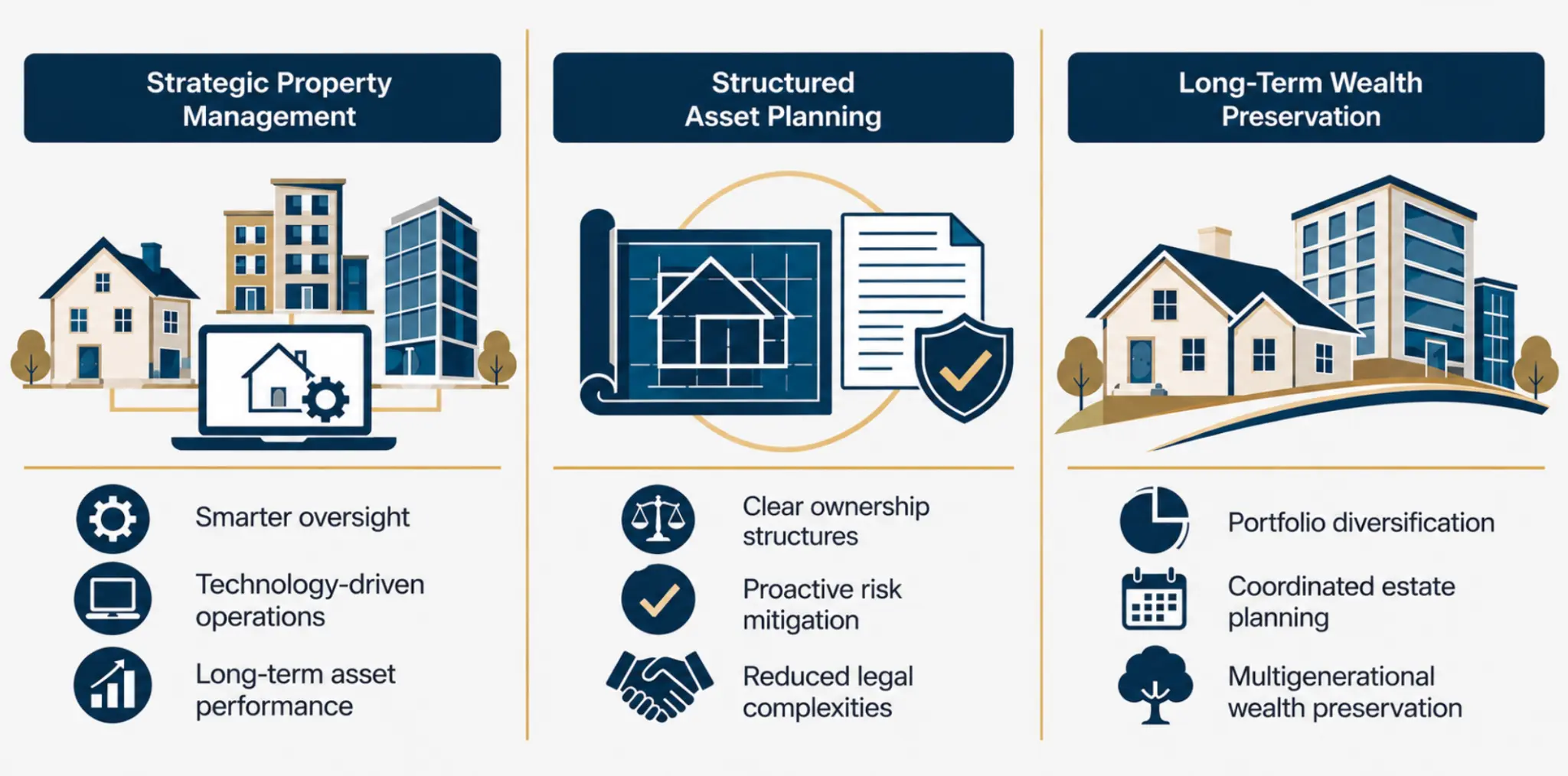
Long-Term Equity Retention through Proactive Estate Alignment
Preserving real estate value over extended holding periods requires ongoing coordination among property managers, legal advisors, and financial planners. Unaligned management strategies often lead to administrative delays, misallocated capital, and unnecessary operational losses.
Effective asset management bridges daily property operations and broader financial objectives. Estate planners and investment managers monitor local real estate laws, zoning changes, and tax code updates to keep holdings fully compliant and strategically positioned.
Understanding the operational and legal framework surrounding co-ownership, asset titling, and capital retention allows property managers to execute seamless transfers, maintain property stability, and preserve long-term generational wealth. Investors are engaged in the real estate market at every level, though trends suggest that the most strategic value extraction is happening in high-value portfolios.





