









Today’s partition law is the product of centuries of legal evolution within the Western world. Its roots trace back to Roman law, where co-owners could split shared property through a process called actio communi dividundo.
As the law developed, it moved beyond the rigidity of early common law courts, offering more flexibility and fairness, especially when a physical split wasn’t practical. Today, modern partition statutes strike a balance between common law rights and equitable discretion.
In simple terms, partition law steps in when co-owners of real estate can’t agree on how to manage, use, or sell the property.
That’s straightforward enough when dealing with a divorcing couple or inherited land, but what happens when the dispute is between business partners?
Here, Underwood Law, a California firm that handles complex partition actions, sheds light on how these laws play out in the business world.
Keep reading to find out how partition law can make—or break—a business relationship.
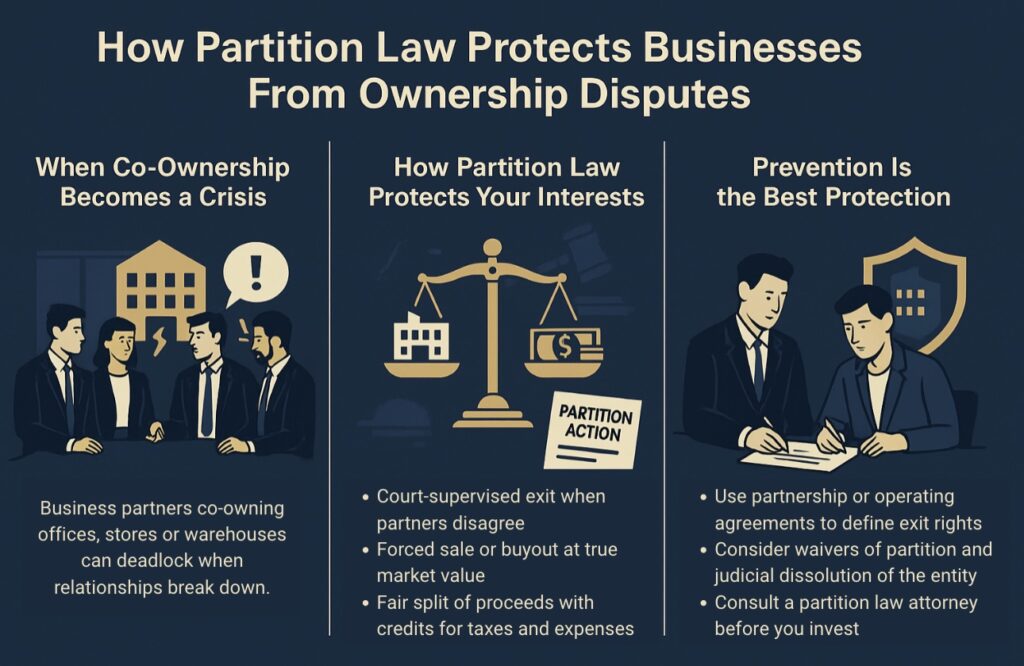
When Co-Ownership Becomes a Crisis
It’s a tale as old as time: Two or more business-oriented people form a partnership to build a strong company. For this purpose, they buy real estate properties (headquarters, brick-and-mortar store space, factories, etc.) and every partner becomes a co-owner.
After a while, disagreements start popping up, and the initial common goal no longer serves as the main driving force. Partners turn on each other, and in the end, the only logical solution is termination.
However, when you’re a co-owner of real estate property, you can’t just sell and be done with it. You need the other co-owners’ permission and agreement, which is incredibly challenging to obtain when relationships break down and are replaced by animosities.
This is where partition law comes in.
How Partition Law Protects Your Interests
Partition law provides a powerful, court-supervised mechanism that offers both an exit strategy and financial protection to business partners in disputes over co-owned business real estate.
Say you and your former partners have hit a deadlock, and you want to cash out. You can petition the court for a partition. If the property can’t be physically divided (partition in kind), the court can order a sale—whether your partners like it or not.
Your (soon-to-be former) partners still have the right to buy out your share to avoid a public sale. If they don’t, the property goes on the market, and everyone walks away with their fair share of the proceeds.
If you’re on the flip side—facing a forced sale initiated by someone else—partition law ensures the process stays fair and transparent. The court brings in an independent appraiser to determine the property’s true market value. Any sale must be approved by the court, often after a competitive bidding process designed to prevent a fire sale price.
Once the sale closes, the court divides the net proceeds based on ownership percentages and contributions. That means if you’ve paid more than your fair share, covering expenses, taxes, or maintenance, you’ll be credited for it before profits are split.
Types of Partition
In general, there are two main types of partition:
- Partition in kind (physical division)
- Partition by sale (forced liquidation)
Where possible, courts prefer the physical division of assets. However, most business disputes that involve real estate are resolved through partition by sale. That’s because commercial properties (office buildings, warehouses, industrial sites, and retail centers) are unified assets. You can’t just saw them into equal parts without gutting their value or functionality.
A partition by sale turns that immovable asset into a clear, liquid asset (cash). This liquidity gives the court room to balance the books fairly, accounting for things like unequal partner contributions, rent collected, or maintenance expenses covered by one party.
It’s the best way to ensure everyone walks away with what they’re rightfully owed. However, it’s not the fastest method. If partners reach a settlement agreement early, the process can take between three and nine months; otherwise, it can drag on for years.
Prevention is the Best Protection
Ending a business partnership is never easy, but it doesn’t have to end in a courtroom showdown. Partners can sidestep the stress of a forced sale simply by having a solid agreement in place that governs each partner’s exit rights.
A well-crafted partnership agreement (for partnerships) or operating agreement (for LLCs) is the best defense against unwanted partition actions or judicial dissolutions. In plain English: It’s the document that keeps your business breakup from turning into a legal brawl.
For example, your agreement can include an explicit, irrevocable waiver of the right to demand partition of company assets or judicial dissolution of the entity. Most courts will uphold these waivers—though in some states, rights tied to serious issues like deadlock, oppression, or fraud are considered fundamental and can’t be waived.
Even so, strong agreement gives the court a clear message: Resolve the dispute under the contract first, not through forced liquidation.
Therefore, the best protection is prevention. In this case, before entering into any partnership, talk to a lawyer specializing in complex business partition action cases. They will advise you on what to include in the agreement and how to take all the necessary prevention measures before it’s too late.