










By Eli Underwood
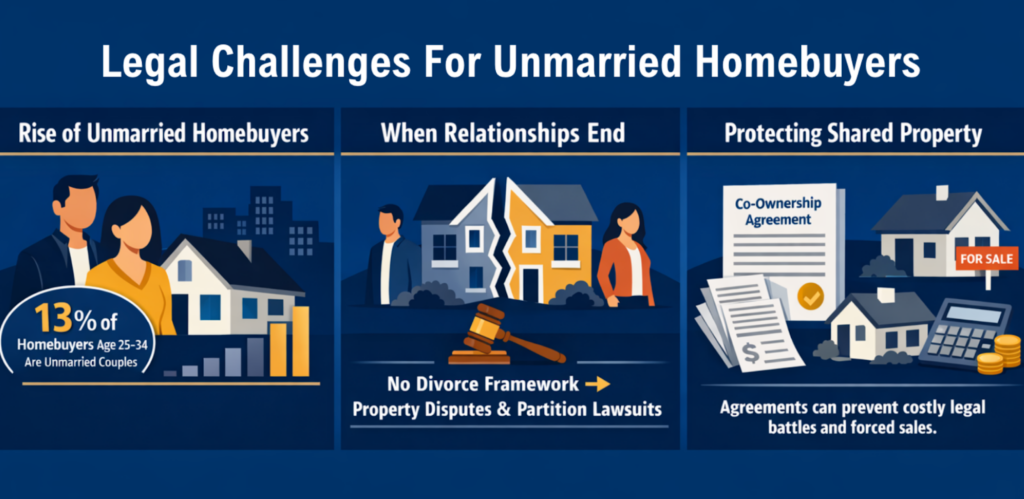
Domestic arrangements are shifting as marriage rates stagnate, but the financial leap into homeownership is not slowing down. According to the National Association of Realtors (NAR) 2025 report, 13% of homebuyers in the 25-34 age demographic are now unmarried couples—a "tipping point" that reveals a massive cohort of buyers entering the market without the legal protections afforded by marriage.
While cohabitation allows younger generations to build capital liquidity in expensive urban markets, it often results in a "utilization inefficiency" of legal rights, leading to a spike in partition trials when these relationships dissolve.
This trend is driven by a variety of social and economic factors, yet several unintended consequences emerge from choosing to buy a home with a partner without "tying the knot."
Specifically, a surge in city dwellers engaging in legal battles over jointly owned property reveals a widespread lack of understanding regarding the implications of committing to a mortgage outside the institution of marriage. When cohabiting couples cannot decide on a unified course of action for a shared asset, they face a landscape of legal complexities that differ significantly from standard divorce proceedings.
Below, Underwood Law, a firm that specializes in partition trials, explores why this trend is leading to a surge in legal disputes and what unmarried co-owners can do to protect themselves.
Changes in Home Ownership and Living Arrangements
Marriage remains the standard for 66% of older Millennials (aged 35-44). However, the numbers tell a different story for younger buyers: A rising tide of single and cohabiting individuals is reshaping the market, prioritizing asset accumulation over legal ceremony.
The younger a buyer is, the higher the likelihood that the property transaction is their first home purchase. Because living costs make shared mortgages a financial necessity, these couples treat homeownership as an operational priority, often overlooking the risk of being "held hostage" by a shared deed in the future.
The Legal Fallout
Uncertainty is the primary problem with long-term live-in partners looking to sell up. Marriage represents a firm legal framework that lays out expectations and responsibilities at all points in a relationship. When married couples decide to split up, divorce proceedings kick into gear and dictate the division of all property, up to and including real estate.
Unmarried couples facing a situation in which major assets must be divided during a separation have no such framework available to them. As a result, one or both parties can end up feeling caught in a trap if there’s no consensus about the age-old question of ‘who gets the house?’
Thankfully, the use of partition agreements can provide a path forward, even if it will still be a painful one. Failing to reach a mutually beneficial decision at this point only leads to mounting legal fees, additional emotional turmoil, and the likely financial repercussions of a forced home sale, including a damaged credit rating.
The Risk-Reward Realities of Modern Home Ownership
Buying a home with a long-term partner before marriage is a trend driven not just by changing social expectations, but more so by the economic realities that young people must contend with today.
Research from the Pew Research Center found that 18% of adults aged 35 and under still live with their parents. This proportion varies regionally, with the highest levels seen in the most expensive urban centers. For instance, the most affluent cities in California have a 33% rate of adult children remaining in the family home.
Rising rents and record house prices mean that average individuals cannot hope to get their foot on the first rung of the property ladder without a helping hand from a third party. For some, this means seeking deposits from their parents. For others, it involves committing to a home purchase with a partner who is not their lawful spouse.
Combined with the fact that average wedding costs now sit at $32,000, it’s easy to understand why this trend has taken hold. Even with the risks of being effectively held hostage if one half of the couple wants to walk away in years to come, it’s still worth it for younger people to pick this path.
What’s Next for Unmarried Homeowners?
Economic and political uncertainty, with the associated inflationary pressures and rising living costs, suggest that the housing market will not get any more affordable in the foreseeable future. Couples from a generation that is already less likely to marry than their forebears can thus be expected to continue buying homes before tying the knot, and a certain proportion of them will eventually need to deal with the legal battles resulting from a relationship breakdown.
Understanding what might happen, acknowledging that there are some limited legal avenues available, and preparing for the fallout of a split from a long-term live-in partner can place today’s homebuyers in a strong position. Those living in urban areas stand to gain the most from being realistic about all this, because there’s more at stake in a home sale situation, and it’s already much harder for them to get on the property ladder in the first place.
For more info, please contact us.