










For heirs and co-owners managing shared real estate portfolios, property illiquidity driven by divergent financial motives has become a primary risk to asset preservation. The friction is quantifiable.
According to a 2023 study by LegalShield, 58% of families face disruptive property disputes or see assets fall under direct court control when multigenerational real estate is transferred without an explicit operational roadmap or partition agreement. While joint ownership functions as a key vehicle for capital accumulation, the lack of a predefined exit protocol frequently traps siblings, co-investors, and family groups in high-stakes stalemates. This analysis evaluates the precise operational and statutory guardrails required to navigate property division amicably, ensuring asset protection without compromising family harmony.
What Causes Family Conflict During Property Partition?
According to Underwood Law, the most common reason family members pursue property partition in the first place is divergent financial needs and goals among co-owners.
The conflict usually arises from unbalanced expectations and decades of unresolved family dynamics, intensified by high financial stakes.
Consider a baseline scenario involving three siblings inheriting a primary investment property. One sibling may be facing debt and need their share of the sale proceeds. On the other hand, another sibling may view the property as an emotional sanctuary or a long-term investment and refuses to sell. Meanwhile, the third sibling is caught in the middle and is forced to choose sides.
If all the siblings agree to keep and maintain the property, another potential source of conflict is uncompensated improvements. When one person has put more work into the property than the others, resentment is almost guaranteed unless there is a preexisting contract.
Conflict also arises when one co-owner pays for the new roof and property taxes while the other co-owners expect an equal split of the proceeds upon partition.
How to Have a Family-Friendly, Amicable Property Partition
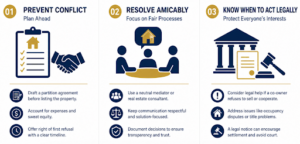
Mitigating interpersonal disputes while protecting joint financial interests typically requires the intervention of a neutral third party. This can be a mediator or a neutral real estate consultant who attends family meetings where property partition is discussed, or a property partition lawyer.
Statutory requirements may render legal counsel mandatory if co-owners reach an unresolvable stalemate or breach fiduciary duties.
If you choose to keep things in the family, here’s what you can do to avoid major conflicts:
Draft a Partition Agreement
Do not wait until you have a buyer to decide how the money will be handled. Executing a preemptive contractual agreement prior to asset marketing ensures transparency.
The agreement should cover things like:
- Which realtor to use (ideally one with no family ties).
- The minimum acceptable offer.
- How to split closing and holding costs (utilities/insurance) until the sale.
Account for Sweat Equity and Expenses
Before splitting the proceeds, make sure everyone’s contributions are noted and accounted for. If one sibling paid the property taxes for five years or replaced the water heater, they should be reimbursed from the top of the sale proceeds before the remaining money is split.
You should also consider documented out-of-pocket maintenance expenses as credits toward the payer’s share. It’s the best way to ensure everyone is satisfied and no accusations of unfairness arise.
Offer Right of First Refusal with a Timeline
If one family member desperately wants to keep the property, give them a fair window to make it happen, but set a hard timeline. As a rule of thumb, 60 to 90 days to secure financing for a buy-out at the agreed-upon appraised price is usually a fair window.
If they cannot secure the funds by the deadline, the agreement must state that the property goes on the open market immediately. This prevents the co-owner’s asset illiquidity, where one person's dream stalls everyone else's financial life.
When to Hire a Property Partition Lawyer
Hiring a lawyer doesn’t mean you’ll be airing family grievances in public. It’s just a way to move things further when nothing else works. Shifting communication to a formal legal intermediary insulates personal relationships from ongoing financial negotiations.
As already mentioned, legal intervention is necessary when one person refuses to sell. In this scenario, you cannot move forward without a court order. Another situation is when a family member is living in the property and refuses to move out or allow potential buyers to view the home.
Other situations include clouded title chains, which usually happen during an inheritance dispute. A lawyer can work with title companies to pursue a quiet title action, clearing the path for the property to be sold to a third party.
Often, simply having a lawyer send a formal demand letter explaining that you are prepared to file a partition action is frequently sufficient to incentivize a voluntary settlement among cooperating tenants in common. A forced court sale will result in a lower price and high legal fees for everyone, so it’s in their best interest to unblock the proceeds.
The Macro Outlook for Fractional Asset Governance
As real estate values remain elevated through 2026, traditional fractional property ownership is projected to increase, accelerating the rate of multigenerational asset transfers. This shift is driving a broader corporate trend toward proactive asset governance over reactive court interventions.
Ultimately, establishing clear capital contribution reconciliations before disputes arise ensures that shared real estate functions as a mechanism for generational wealth preservation rather than an operational liability.