









By Eli Underwood
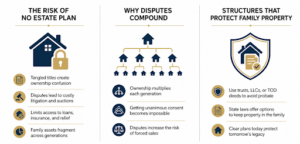
Property owners who skip estate planning are walking into a financial trap. Tangled titles pile up. Fractional ownership disputes multiply. Forced partition auctions drain equity. Family assets fragment across generations, and there's no easy way back.
Without clear documentation—without wills, without trusts, without written agreement on ownership—properties get locked down. Owners can't refinance. They can't access improvement loans or disaster relief. One generation's oversight becomes exponential claims across children, grandchildren, and cousins. Unanimous consent becomes impossible. Litigation becomes inevitable. Estate planning isn't optional. It's the difference between protecting what you've built and watching it fracture in court.
How Tangled Titles Lock Away Billions in Family Wealth
Data points on this topic are provided by the Urban Institute in its assessment of the Uniform Partition of Heirs’ Property Act (UPHPA), legislation applicable in 24 states and two territories of the U.S. Researchers report that around 40% of homeowners aged 50 and above have no estate plan or will in place, while an estimated 3.8% of real estate, worth over $243 billion, is tied up in titles that are likely to be disputed. Known as a tangled title, this essentially signifies real estate that has an apparent owner who’s not named on the deed.
According to Underwood Law, a partition action law firm based in California, the main source of disputes is the shared ownership of inherited property, especially if this is not clearly defined in a will but merely stems from a state of ‘tenancy in common’, where there’s no clear definition of which heir owns which portion of a property. If one owner wants to sell and the other does not, a party can file a partition action to seek court intervention and initiate an auction to settle the dispute at auction.
Similarly worrying data on this issue comes courtesy of the Lincoln Institute of Land Policy, citing findings from Fannie Mae alongside other sources. Researchers contend that in high-risk rural and peri-urban counties across the U.S., up to 42% of real property qualifies as heirs' property with tangled titles, accounting for tens of billions in under-secured real estate wealth.
Aside from ownership disputes, this research provides a broader picture of the problems that arise from a lack of estate planning, where informal tenure emerges . Occupants cannot access mortgage refinancing, home improvement loans, property insurance, or disaster relief funds without 100% written consent from every co-heir.
Why Fractional Ownership Multiplies Disputes Across Generations
Protecting family real estate through proper estate planning is doubly important because the issues of multiple ownership and heirship claims compound over time and across generations. One study in the Journal of the Southern Rural Sociological Association looked specifically at identifying heirs' property challenges in the Southern U.S. and the Appalachian region.
This 11-state spatial analysis identified 496,994 parcels of heirs' property spanning 5.3 million acres valued at $41.9 billion, and pointed out that fractional ownership becomes exponential. So, in the example of one original owner having four children, who in turn have a combined 16 grandchildren, each with a potential claim in the event of an inheritance without a will or estate plan. Getting unanimous consent from all heirs becomes impossible. In this case, unanimous consent for land management is impossible, and the absence of a plan dramatically increases the statistical likelihood of an internal family dispute or forced partition sale.
Three Legal Structures that Prevent Forced Asset Sales
The need to protect family property through proper estate planning is apparent, and there are many options and structures for families to choose from to handle this in a fair and legally robust way. For example, Living Trusts, LLCs for family real estate, or Transfer-on-Death (TOD) deeds bypass probate, prevent fractionated ownership, and eliminate partition sale risks.
Likewise, there are many states where the UPHPA has been implemented already, or will soon be enforced. This legislation requires courts to offer right-of-first-refusal buyout options to co-heirs before ordering an auction and reduces the likelihood that a partition action will be necessary.
Even so, the knowledge that a partition action can be used as a last resort to settle contested property ownership shows that a path forward exists. Creating clarity through estate planning, overseen by a legal professional, is better than leaving anything to chance for property owners and their heirs.